
Class 12 Biology Competency-Based Questions Chapter 9
1 Mark Questions
1, Two statements are given below – one labelled Assertion (A) and the other labelled Reason (R).
- Assertion (A): Single-cell proteins have the potential to meet the growing demand for food and eliminate hunger.
- Reasoning (R): The yield of proteins from conventional agriculture is more than the yield of proteins from microbes.
Which of the following is correct?
A. Both A and R are true, and R is a correct explanation for A.
B. Both A and R are true, and R is not a correct explanation for A.
C. A is true, but R is false.
D. A is false, but R is true.
Ans: C. A is true, but R is false.
2. Two statements are given below – one labelled Assertion (A) and the other labelled Reason (R).
- Assertion (A): The micropropagation of the plants does not depend on reproductive structures.
- Reason (R): Some plant parts have the property of totipotency.
Which of the following is correct?
A. Both A and R are true, and R is a correct explanation for A.
B. Both A and R are true, but R is not a correct explanation for A.
C. A is true, but R is false.
D. A is false, but R is true.
Ans: A. Both A and R are true, and R is a correct explanation for A.
3. There are about 450 globally recognised dog breeds. One such breed is the Goldador, formed by a cross between two commonly known dog breeds – the Golden Retriever and the Labrador Retriever.
Which of the following statements describes the parents of the first Goldador
dog correctly?
A. They belong to different genus and species.
B. They belong to the same genus and species.
C. They belong to same genus but different species.
D. (Cannot say without knowing their common ancestor.)
Ans: B. They belong to the same genus and species.
4. Four students are artificially propagating a tomato plant using tissue culture.
Shown below is a representation of the parent plant and particular parts from
which the students isolated cells.
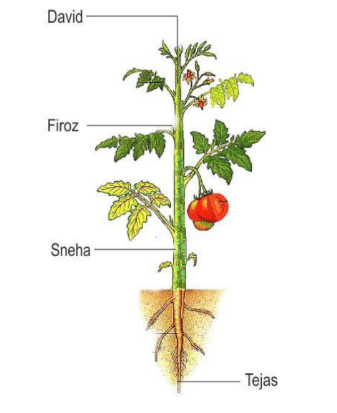
After 10 days, the parent plant exhibited curling and yellowing of leaves, which are symptoms of tobacco mosaic virus. The incubation period of the virus is approximately 1-3 weeks.
Which of the following students’ tissue culture experiments will give rise to diseased plants?
A. David
B. Firoz
C. Sneha
D. Tejas
Ans: C. Sneha
5. Two statements are given below – one labelled Assertion (A) and the other labelled Reason (R).
- Assertion (A): The progeny of cross-hybridisation must undergo selection and testing.
- Reason (R): Some hybrids lack the desired combination of their parents’ characteristics.
Which of the following is correct?
A. Both A and R are true, and R is a correct explanation for A.
B. Both A and R are true, but R is not a correct explanation for A.
C. A is true, but R is false.
D. A is false, but R is true.
Ans: A. Both A and R are true, and R is a correct explanation for A.
6. Two statements are given below – one is an Assertion (A) and the other is Reasoning (R).
Assertion (A): Continued inbreeding increases fertility and heterozygosity.
Reasoning (R): Closely related individuals within the same breed who do not have a common ancestor for 4-6 generations are mated to develop pure lines.
Which of the following is correct?
A. Both A and R are true, and R is a correct explanation for A.
B. Both A and R are true, but R is not a correct explanation for A.
C. A is true, but R is false.
D. A is false, but R is true.
Ans: D. A is false, but R is true.
7. In Multiple Ovulation Embryo Transfer Technology (MOET), a sheep that acts as the genetic mother is artificially inseminated. The embryos are recovered non-surgically and transferred to surrogate mothers.
What is the purpose of having separate genetic and surrogate mothers?
A. The surrogate mother has a shorter pregnancy term.
B. The genetic mother cannot mate with the bull naturally.
C. The surrogate mother cannot produce multiple eggs per cycle.
D. The genetic mother can undergo multiple rounds of superovulation.
Ans: D. The genetic mother can undergo multiple rounds of superovulation.
8. A laboratory is developing a hybrid Basmati rice cultivar with the objective of increasing grain length. The following are some details:
- Desired characteristics: require less water and mature earlier than traditional Basmati cultivars.
- Parent cultivars: Pusa 614–1-2 and Pusa 614–2–4-3. States grown in: Punjab, Haryana, and Uttarakhand.
- A scientist outlined the steps for testing it before the release:
- Growing the cultivar in research fields
- Recording yield under ideal irrigation
- Growing in farmers’ fields for at least three growing seasons at several locations in the country, representing all the agroclimatic zones where the crop is usually grown.
As a fellow scientist, you have to recommend another key aspect of testing that your colleague has missed. Select the appropriate recommendation from below.
A. Growing in coastal belts of India
B. Cultivating for at least 4 growing seasons
C. Choosing parents with disease resistance
D. Comparing the yield against a reference cultivar
Ans: D. comparing the yield against a reference cultivar
9. The Neelagiri breed of sheep is distributed in Tamil Nadu. For a few generations, the animals have been producing poor-quality wool.
To improve the wool quality, one Neelagiri sheep has been selected for outcrossing with another sheep. Select the statement that describes the relationship between the two sheep.
A. They are animals of different breeds.
B. They are animals of different species.
C. They are related animals of the same breed.
D. They are unrelated animals of the same breed.
Ans: D. They are unrelated animals of the same breed.
10. Consider two statements.
The capacity to generate a whole plant from any cell is called totipotency.
Any part of a diseased plant can be cultured in laboratory to recover healthy plants.
Choose the correct option.
A. Statement I is true, and II is the reason.
B. Statement II is true, and I is the reason.
C. Statement I is true, but statement II is false.
D. Statement II is true, but statement I is false.
Ans: C. Statement I is true, but statement II is false.
11. Complete the following sentence by selecting the correct option.
The tangelo is a fruit produced by crossing Citrus reticulata and Citrus maxima plants. It is an example of.
A. inbreeding
B. out-crossing
C. cross-breeding
D. interspecific hybridisation
Ans: D. interspecific hybridisation
12. Somatic hybridisation is the artificial technique of creating a hybrid plant combining the desirable characteristics of two plants.
Which of the following conditions MUST be satisfied by the two cells used for somatic hybridisation?
A. They are gametes.
B. They lack cell wall.
C. They contain chlorophyll.
D. They belong to same species.
Ans: B. They lack cell wall.
2 Marks Questions
13. The image below shows the milestones of tomato crop.
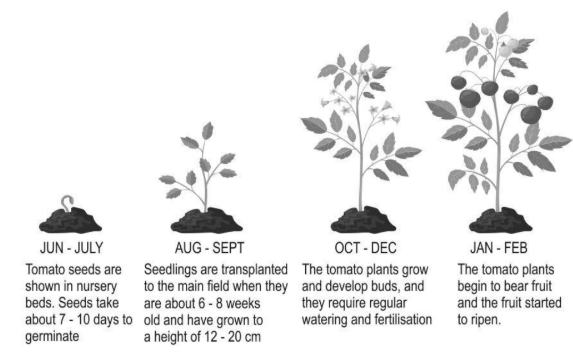
In which of the four milestones will the presence of beehives containing Apis indica be most beneficial? Provide a reason.
Ans:
- October – December
- Flower buds develop from October to December. The flowers will be pollinated by bees and yield better crops and honey.
14. Mark the following statements as true or false and provide a reason.
(a) Artificial insemination has a higher rate of success than normal mating concerned with animal breeding.
(b) In herd improvement experiments, artificial insemination is performed first, followed by super-ovulation.
Ans:
(a) True. Artificial insemination maintains safer mating conditions
OR
Artificial insemination helps overcome geographical barriers in uniting the male and female.
(b) False. Super-ovulation is done first, followed by artificial insemination.
15. As a beekeeper, which of the three options would you pick to set up a bee farm and why?
(i) an agricultural land surrounded by an orchard
(ii) a barren patch of land next to a chemical factory
(iii) a grassy piece of land behind an under-construction residential building
Ans:
Option (i). Reason – Bees will pollinate the orchard trees, and the honey yield will be high
16. Mark the following statements as true or false and provide a reason for each.
(a) Mutation breeding involves the insertion of specific genes into the plant genome.
(b) Micropropagation increases the vulnerability of the plant population already vulnerable to environmental stresses.
Ans:
- (a) False. Mutation breeding involves the induction of random or spontaneous mutations in the plant’s genome, artificially through the use of chemicals or radiation.
- (b) True. Plants produced by micropropagation will be genetically identical to the original plant from which they were grown.
17. Two laboratories (Alpha and Bravo) executed different approaches to create a mustard plant variety that is resistant to aphids. Alpha laboratory followed the steps of the conventional breeding technique as described below.
- Germplasm collection
- Evaluation and selection of parents
- Cross-hybridisation among selected parents
- Selection and testing of superior recombinant
- Testing, release, and commercialisation of new cultivars
Bravo Laboratory followed mutation breeding to develop a pest-resistant variety of mustard.
Which step of Alpha’s approach would be different from Bravo’s approach?
In the mutation breeding method, how is the step identified in (a) different?
Name two ways by which Bravo Laboratory could introduce variation in the mustard plant.
Ans:
- Step I
- Genetic variability is introduced by artificial means.
- Exposure to chemicals and Exposure to radiation
3 Marks Questions
18. Read the following scenario and answer the questions that follow.
Parent 1: Brandywine tomato variety known for its large size and excellent flavor.
Parent 2: Sun Gold tomato variety known for its small size, sweet taste, and disease resistance.
(a) Rectify the statement given below by rewriting it.
“Crossbreeding of parent 1 and parent 2 will always yield better progeny than inbreeding parent 2 with its offspring.”
(b) Support your answer to (a) by clearly stating the purpose and outcome of both methods of plant breeding.
Ans:
(a)
- Crossbreeding of parent 1 and parent 2 will not always yield better progeny than inbreeding parent 2 with its offspring.
OR
- Neither crossbreeding nor inbreeding will always yield better progeny.
(b)
- Crossbreeding produces hybrids and increases the genetic diversity/heterozygosity of the population
- Inbreeding produces purebreds and preserves specific superior traits/increasing homozygosity of the population
19. Consider two fields having the same number of plants.
Field A contains plants of the Cavendish banana variety known for firm texture, high yield, and resistance to fungus, but sensitivity to other biotic stresses.
In field B, seeds produced from a cross between two different banana varieties (Gros Michel and Manzano) were sown. Gros Michel is known for its excellent flavor and creamy texture, but lacks disease resistance. Manzano is known for its small size and resistance to biological stresses.
(a) The plants of which field will yield bananas with
(i) varied characteristics
(ii) uniform characteristics
(b) If both fields are attacked by aphids, which field will likely have most number of affected plants? Provide reason.
(c) In the event of a fungal attack, which field which field will likely have most number of affected plants? Provide reason.
Ans:
- (a)
- (i) field B
- (ii) field A
- (b)
- Field A
- All plants are genetically identical or somaclones of the parent that lacks resistance to aphids.
- (c)
- Field B
- The parents do not carry fungal resistance.
20. Controlled breeding experiments are carried out by performing artificial insemination.
(a) State TWO advantages of artificial insemination that overcome problems of natural insemination.
(b) Semen is mainly made of protein. State why semen needs to be transported in a frozen manner before artificial insemination is performed.
Ans:
- (a)
- The spread of diseases/infections is low as artificial insemination is performed in controlled, sterile conditions.
- Desired traits can be obtained in the offspring of animals that are inseminated artificially.
- (b) Proteins get denatured at room temperature and stress conditions, and so need to be frozen to preserve their condition.
21. Shown below is the family tree of a horse, Cunco, who was bred to participate in racing. His ancestor, Northern Dancer, was a champion horse who won 14 out of 18 races in his lifetime and fathered many horses for breeding future champions.
Answer the questions that follow based on the tree shown below.
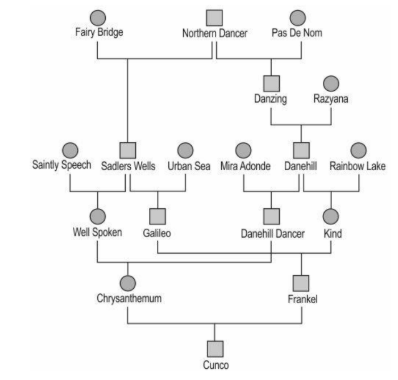
(a) How many inbred horses are there?
(b) Name all the inbred horses identified in (a).
(c) If Well Spoken and Galileo are bred, name one risk that the offspring would possess.
(d) Cunco is a descendant of Northern Dancer; however, he performed poorly in all the races. What kind of mating will be fruitful to restore racing champion characteristics in the next generation?
Ans:
- (a) 3
- (b)
- Chrysanthemum
- Frankel
- Cunco
- (c)
- Reduced fertility
- Reduced productivity
- Build-up of harmful recessive genes
- (d) Out-breeding/out-crossing OR crossing with unrelated racing horses from the same breed
22. Black rot disease is caused by the bacteria, Xanthomonas campestris, which affects cauliflower. A plant laboratory is focused on developing a cauliflower variety that is resistant to black rot infection.
(a) Name two sources from which the laboratory can obtain resistant genes.
(b) The laboratory attempts were unsuccessful as they used conventional breeding techniques. Highlight any one aspect of (a) that could have caused failure.
(c) Name two alternative breeding techniques that the laboratory can use to develop the desired variety of cauliflower.
Ans:
- (a)
- Cultivated varieties of cauliflower
- Germplasm collection of the cauliflower crop
- Germplasm collection of wild species related to the cauliflower plant
- (b) lack of or limited disease-resistant varieties in the germplasm
- (c)
- Somaclonal variation
- Mutation breeding
23. (a) The Rotolactor is an automatic machine used for milking a large number of cows successively on a rotating platform. State one advantage of the Rotolactor over manual milking of cows.
(b) List two practices for maintaining a dairy farm that uses machines for milking cows.
Ans:
- (a)
- Reduced the chance of contamination from the handler
- Handler is available for other tasks associated with the management of the dairy farm
- (b)
- Stringent cleanliness and hygiene of the milking machine and dairy farm
- Regular inspection and record keeping of the milking machine
- Regular visits by a veterinary doctor
24. The first successful wheat-rye somatic hybrid was created in 1968 by using protoplast fusion. The hybrid combined desirable traits from both wheat and rye, such as resistance to disease and cold temperatures.
(a) Which part of the cell protects the integrity of the protoplasts from the wheat and rye plant?
(b) The wheat and rye protoplasts each had one nucleus. How many nucleus/nuclei would the hybrid have?
(c) A scientist is attempting the above experiment. He isolated pollen grains from the wheat plant and an egg cell from the rye plant. The cells were subjected to a chemical treatment that turned them into protoplasts. The fusion of protoplasts from a wheat plant and a rye plant will yield a somatic hybrid. Is the statement true or false? Give reason.
(d) Name the artificial process by which the single-cell somatic hybrid would develop into a plant?
(e) (i) Will the plants produced from the single hybrid cell be identical to each other?
(ii) Will the hybrid plants be identical to the parents?
Ans:
- (a) Plasma membrane or cell membrane
- (b) Two
- (c)
- False
- Gametes cannot be used for somatic hybridisation.
- (d) tissue culture
- (e)
- Yes
- No
4 Marks Questions
25. Sugarcane varieties that were earlier found in North India did not have enough sugar content. So, scientists decided to initiate a project to develop varieties of sugarcane that produce higher content of sugar.
Given that the scientists had no prior information about sugarcane, describe the steps that they need to go through to create a high-sugar variety of sugarcane that can be tested.
Ans:
- Collection of variability: The team will need to collect and preserve all the different wild varieties, species, and relatives of the cultivated species (followed by their evaluation of their characteristics) for effective exploitation of natural genes available in the populations.
- Evaluation and selection of parents: The germplasm is evaluated to identify plants with a desirable combination of characteristics. These parents are multiplied to create pure lines.
- Cross-hybridization among the selected parents: The parents are cross-hybridized to produce variants with the desired characteristics.
- Selection and testing of the best recombinants: Since not all offspring may have the desired characteristics, it is important to select those that have the desired combination from among all the progeny. These are self-crossed for several generations till homozygous plants are obtained for testing.
Additional Study Materials
- Sexual Reproduction in Flowering Plants- Competency-Based Questions
- Human Reproduction – Competency-Based Questions
- Reproductive Health – Competency-Based Questions
- Principles of Inheritance and Variation – Competency-Based Questions
- Molecular Basis of Inheritance – Competency-Based Questions
- Evolution – Competency-Based Questions
- Human Health and Disease – Competency-Based Questions