NIOS Biology Intext Solutions Chapter 22
INTEXT QUESTIONS 22.1
1. Name the founder of genetics and state why he is called so.
Ans: Gregor John Mendel was the first to suggest principles underlying heredity.
2. State one difference between
(i) homozygous and heterozygous individuals
(ii) dominant and recessive traits
(iii) genotype and phenotype
(iv) monohybrid and dihybrid crosses.
Ans:
- (i) An individual possessing identical alleles for a trait is termed homozygous. An individual with dissimilar alleles for a trait is termed heterozygous.
- (ii) Dominant trait is the one which expresses itself in a heterozygous conditions. Recessive trait is the one which is not expressed in heterozygous condition but expressed in homozygous conditions.
- (iii) Genotype is the genetic constitution of an individual, represented with the help of symbols. Phenotype is the class of individuals recognized based on externally/internally visible characters.
- (iv) Monohybrid cross is between two parents differing in a single pair of contrasting characters. Dihybrid cross is between two parents differing in two pairs of contrasting characters.
3. Define heredity and genetics.
Ans:
- Heredity is the study of the transmission of characters from one generation to the next.
- Genetics: The study of the science of heredity and the reasons governing the variation between the parents and their offspring is called genetics.
4. Give the monohybrid and dihybrid phenotypic ratios for Mendelian inheritancce.
Ans: Monohybrid ratio = 3 : 1
Dihybrid ratio = 9 : 3 : 3 : 1.
5. Mention two sources of variation.
Ans: Mutation, Recombination.
INTEXT QUESTIONS 22.2
1. Define : (i) An allele (ii) Codominance (iii) Polygenes (iv) Lethal genes
Ans:
- (i) Alleles are different forms of a gene.
- (ii) Both alleles express as a dominant phenotype.
- (iii) Many genes control the same trait.
- (iv) Presence of which kind of genes in an individual proves to be fatal.
2. Name the kind of inheritance in terms of expression of
(i) blood groups of humans (ii) wheat kernel colour (iii) human skin colour?
Ans:
- (i) Codominance and multiple alleles
- (ii) Incomplete dominance
- (iii) Polygenic inheritance
- (iv) Polygenic inheritance
3. State the phenotypic monohybrid ratio in case of incomplete dominance.
Ans: 1: 2: 1
INTEXT QUESTIONS 22.3
1. What are genes, and where are they located?
Ans: Genes are segments of DNA. They are located in chromosomes.
2. State the names of the scientists who proposed the chromosomal theory of inheritance.
Ans: Sutton and Boveri
3. Define (i) linkage and (ii) crossing over.
Ans:
- (i) Linkage is the tendency of genes residing on the same chromosome to be inherited together.
- (ii) Breakage and exchange of genes between two chromatids of a homologous pair is termed crossing over.
4. When does gene exchange through chiasma formation occur between homologous
chromosomes?
Ans: Gene exchange through chiasmata formation occurs during prophase I of meiosis
5. Why is the human female called the homogametic sex?
Ans: A Human female is called a homogametic sex because they produces only one kind of gamete (homo = same)
6. A colour blind man married a normal woman whose father and mother both had normal colour vision. Will any of their sons be colour blind? If not, why not?
Ans: No. Because the gene for color blindness on the X chromosome is recessive so it is marked by a recessive gene from the mother.
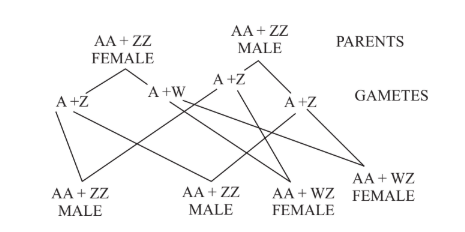
7. With the help of flow chart, explain the difference in sex determination in birds and mammals.
Ans: Sex Determinaiton in Birds
In birds, both sexes (male and female) possess two sex chromosomes, but unlike human beings, the female has the heteromorphi,c morphologically different sex chromosomes (ZW), while the males bear homomorphic (condition, the sex chromosomes (ZZ). Thus, the females are heterogametic and produce two types of eggs: A+Z and A+W (‘A’ stands for autosomes). The male gamete is only of one type: A+Z. This type of sex determination is called the ZW-ZZ type or the WZ-ZZ type of sex determination. The letters Z and W are used to distinguish these types of sex chromosomes from X and Y chromosomes found in the X-Y type of sex determination.
Sex Determination in Mammals
Sex chromosomes in males are morphologically dissimilar (i.e., XY). Such individuals produce two types of gametes (one containing X and the other containing Y) and are called heterogametic. For example, a human male produces two kinds of sperm, X-bearing and Y-bearing sperm. When the human egg is fertilized by an X-bearing sperm, a girl is born, and if the human egg is fertilized by a sperm having “Y” chromosome, a boy is born (Fig. 22.6). Whether the unborn will be a male or female is purely a matter of chance, and no parent can be blamed for the sex of the progeny.
8. Name an insect in which all males are produced parthenogenetically.
Ans: Honey bees.
9. In honey bees, “males have no father and cannot have sons but have a grandfather”. Justify the statement.
Ans: Because males develop from unfertilised or haploid eggs and females from fertilised or diploid eggs.
10. Which sex in birds is heterogametic?
Ans: Female.
11. Why is sex determination in honeybees called haplodiploidy?
Ans: In honey bees, fertilised eggs emerge as females and unfertilised eggs develop into males. Since fertilised eggs and also females are diploid, and unfertilised eggs and males are haploid, sex-determination in honey bees is referred to as haplodiploidy-sometimes also called arrhenotoky.
INTEXT QUESTIONS 22.4
1. Why is mitochondrial inheritance treated as a case of maternal inheritance?
Ans: Because mitochondria are inherited from the mother through the ovum.
2. Into how many groups have human chromosomes been grouped in the human karyotype?
Ans: Seven
3. State the chromosomal abnormality in Klinefelter’s syndrome, Turner’s syndrome, and in Mongolism.
Ans:
- Kline felter : 2n = 47; XXY
- Turner : 2n = 45; XO
- Mongolism : 2n = 47;
- Trisomy of chromosome 21
Additional Study Materials
- Chapter 19 Reproduction in Plants
- Chapter 20 Growth and Development in Plants
- Chapter 21 Reproduction and Population Control