NIOS Biology Intext Solutions Chapter 17
INTEXT QUESTIONS 17.1
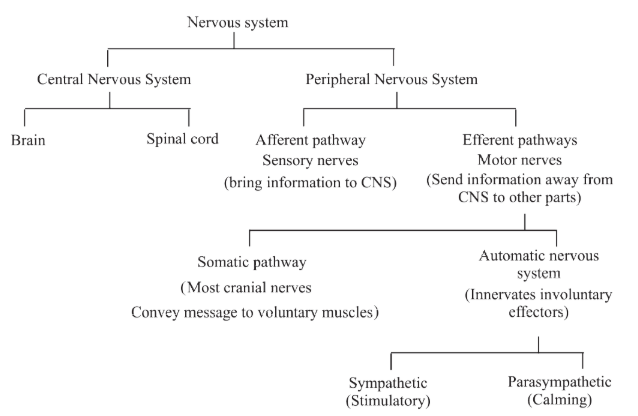
1. With the help of a flow chart, write down the basic components of the nervous system in the space given below.
2. Name the ganglia which
(a) forms the brain
(b) lies below the oesophagus and is joined to brain.
Ans:
- (a) Supraesophageal ganglion
- (b) Suboesophageal ganglion
3. Which part of nervous system of cockroach can be compared to our spinal cord, though our spinal cord is dorsal, and this part of nervous system of cockroach is ventral?
Ans: Ventral nerve cord
4. Name the main parts of the brain.
Ans: Cerebrum, cerebellum, medulla oblongata, thalamus, and hypothalamus
5. Mention the one function each of :
(i) Cerebrum
(ii) Cerebellum ……
(iii) Medulla oblongata
(iv) Hypothalamus..
Ans:
- (i) Cerebrum–intelligence/thinking/reasoning/memory;
- (ii) Cerebellum– balance/muscular coordination
- (iii) Medulla oblongata–involuntary actions
- (iv) Hypothalamus–homeostasis
6. What are the
(i) gray matter, and….
(ii) white matter made of?
Ans:
- (i) Gray matter–composed of neuron cell bodies
- (ii) White matter–composed of axon fibres
7. Name the fluid in the cavities of the brain.
Ans: Cerebrospinal fluid
INTEXT QUESTIONS 17.2
1. What are the two subdivisions of the autonomic nervous system?
Ans: The two subdivisions of the autonomic nervous system are the sympathetic nervous system and the parasympathetic nervous system.
2. Name the specific subdivisions of the autonomic nervous system concerned with the following:
(i) Slowing down heartbeat..
(ii) Increasing salivary secretion……..
(iii) Dilatation of the pupil.
(iv) Increasing intestinal peristalsis ….
(v) Muscle contraction of the urinary bladder giving the feeling the need for urination.
Ans:
- (i) Parasympathetic nervous system
- (ii) Parasympathetic nervous system
- (iii) Sympathetic nervous system
- (iv) Parasympathetic nervous system
- (v) Parasympathetic nervous system
3. Why is the peripheral nervous system called so?
Ans: The peripheral nervous system is called so because it connects the periphery (surface) of the body
4. State the alternative terms for sensory and motor nerves.
Ans: sensory = afferent, motor = efferent
INTEXT QUESTIONS 17.3
1. Given below are a few examples of reflexes. Write against each, the category of reflex, whether simple or conditioned.
(i) Knee-jerk
(ii) Salivation on seeing a favorite dish….
(iii) Tying of shoe laces while talking …….
(iv) Closing of eyelids if a strong beam of light is flashed across …..
(vi) Mistaking a coiled rope a snake if you happen to step on it in darkness
Ans:
- (i) Simple
- (ii) Conditioned
- (iii) Conditioned
- (iv) Simple
- (v) Conditioned
INTEXT QUESTIONS 17.4
1. State the function of the following parts of the eye:
(i) Iris
(ii) Ciliary muscles
(iii) Pupil …….
(iv) Vitreous humour
(v) Retina
Ans:
- (i) Contracts and dilates pupil
- (ii) Helps in near vision/contracts to make the lens thicker
- (iii) Controls the amount of light entering the eye
- (iv) Maintains the shape of the eye ball and protects retina
- (v) Produces nerve impulses into the optic nerve
2. Name the following:
(i) Area of sharp vision in the eye ..
(ii) The kind of lens used for correcting near-sightedness …….
(iii) The condition in which the lens of the eye turns opaque.
(iv) The capacity of eye to focus objects at different distances
Ans:
- (i) Yellow spot
- (ii) Concave lens
- (iii) Cataract
- (iv) Accommodation
INTEXT QUESTIONS 17.5
1. Which part of the ear is involved when:
(i) A gymnast performs various balancing feats.
(ii) You hear a song.
Ans:
- (i) Vestibule
- (ii) Cochlea
2. Name the following :
(i) The part into which the sound waves are directed by the ear pinna.
(ii) The kind of balance with which the semi-circular canals are concerned.
(iii) Any two sensations felt through free nerve endings in the skin.
Ans:
- (i) Auditory meatus
- (ii) Static balance
- (iii) Touch/pressure/warmth/cold/…
INTEXT QUESTIONS 17.6
1. Name the following
(i) The organ in the neck on the trachea, close to which thyroid is located
(ii) The condition caused due to oversecretion of thyroxin
(iii) The hormone concerned with facing dangers
(iv) The condition of passing much glucose in the urine
(v) The source gland of ADH
Ans:
- (i) Larynx
- (ii) Cretinism
- (iii) Adrenaline
- (iv) Diabetes mellitus
- (v) Posterior pituitary
2. What are pheromones?
Ans: Pheromones are secretions from one individual that are given out into the environment and which elicit a response in other members of the same species.
Additional Study Materials
- Chapter 06 Root system
- Chapter 07 Shoot system
- Chapter 08 Absorption, Transport, and Water Loss in Plants
- Chapter 09 Nutrition in plants – Mineral Nutrition
- Chapter 10 Nitrogen Metabolism
- Chapter 11 Photosynthesis
- Chapter 12 Respiration in Plants
- Chapter 13 Nutrition and Digestion
- Chapter 14 Respiration and Elimination of Nitrogenous Wastes
- Chapter 15 Circulation of Body Fluids
- Chapter 16 Locomotion and Movement






Fantastic blog! Do you have any tips and hints for aspiring writers? I’m planning to start my own website soon but I’m a little lost on everything. Would you suggest starting with a free platform like WordPress or go for a paid option? There are so many options out there that I’m totally confused .. Any ideas? Thanks!