
Translocation chromosomal aberration was first discovered by Bridges.
Translocation Chromosomal Aberrations
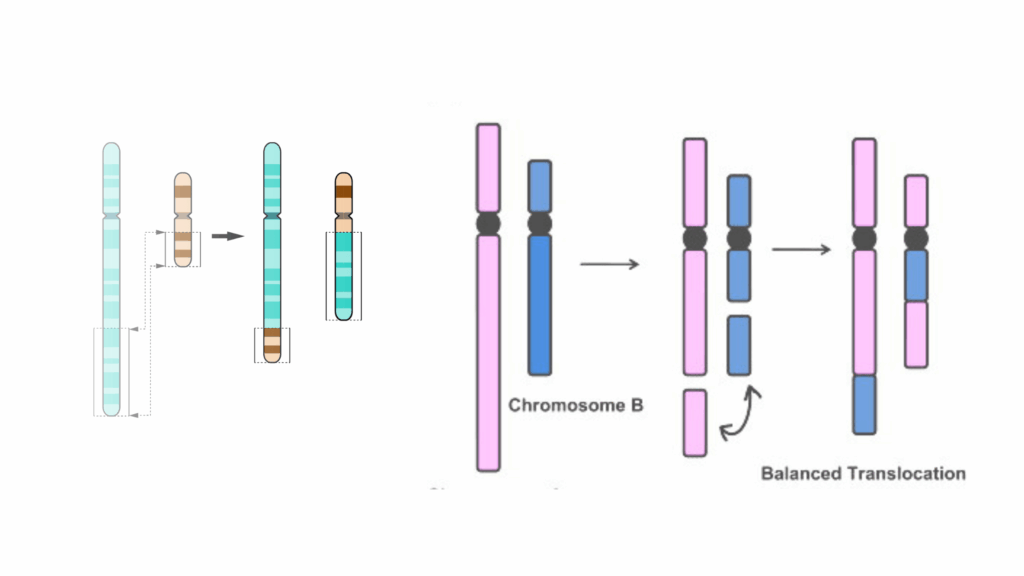
Translocation chromosomal aberrations are a type of structural aberration that affects at least two chromosomes. In translocation, a segment is removed and attaches itself to another non-homologous chromosome or a different part of the same chromosome.
Types of Translocation Chromosomal Aberrations
It can be of three types.- Reciprocal, simple, and shift translocations
Reciprocal Translocation
The fragment of two chromosomes and the mutual exchange through the reunion of fragments is called reciprocal translocation. It needs two breaks in two different chromosomes and a subsequent rejoining of the cut ends. The two new chromosomes will function normally if each possesses a single centromere.
Simple Translocation
Another type of translocation is simple translocation. It involves the transfer of the end of one chromosome to the end of another one. Such translocations occur very rarely in nature. The telomeres of unfragmented chromosomes prevent the terminal addition of extra pieces of chromosomes.
Shift Translocation
A shift translocation is one in which the interstitial segment is removed from the arm of one chromosome and is reinserted into the same arm but at a different location, or shifted to an interstitial position on another arm or to a non-homologous chromosome.
Homozygous and Heterozygous Translocations
Translocation chromosomal aberrations may be homozygous or heterozygous.
In the former, both chromosomes concerned are of translocated types, and in the latter, one is normal and the other is translocated. An organism developed from such a zygote will be a translocation heterozygote.
When reduction division occurs in the above translocation, heterozygous chromosomes do not come in pairs, as in normal cases. Instead, they form a four-armed figure or a cross-shaped configuration. Arms variably form a common point, and each arm consists of a pair of homologous segments. This is the only way in which the homologous segments of all the chromosomes can pair throughout their length.
The chromosomes separate in the middle region but remain attached for some time. At times, they form a circle where the normal chromosomes AB and CD alternate with translocated ones AD and CB.
Sometimes the circle may get twisted in the form of an ‘8’. When this happens, the alternate chromosomes of the former ring fall at the same pole, a metaphase. As a result, the normal chromosomes AB and CD go to one gamete, and the translocated ones AD and CB go to the other gamete. However, if the circle does not twist AB and CD form one pole, AD and CB might form the other pole.
On the other hand, if the spindle is formed in another direction, AB and CB go to the same gamete, and CD and D go to the other one. In the first case, one gamete B is duplicated and lacks D, while the other one has D duplicated and lacks B. Thus, when adjacent chromosomes of a ring go to the same pole, the resulting gamete contains one normal chromosome and one translocated chromosome.
Origin of Translocations
There are four possible origin for translocations in chromosomes. It can be mechanical shear, formaiton of interlocked bivalents, by physical and chemical agents, or crossing over in homologous regions.
- Mechanical shear: The entaglement at interphase or prohase causes mechanical shear. These broken segments reunite with the non-homogous chromosomes.
- Formation of interlocked bivalents: In prophase of meiosis, when the non-homologous chromosome passes thoguh the loop of two homologous chromosomes, they interlock to form bivalents. When they separate during anaphase, there will be a breakage and a reunion causing translocations.
- Physical and chemical agents: X-rays and some chemical agents can induce breakage in non-homologous chromosomes causing translocation. It mostly occur naturally as plants are exposed to envrionmaetal agents.
- Crossing over in homologous regions: Some non-homologous chromosomes have duplicated segments that are homologous to each other. A crossing over in such segments can lead to translocation.
Importance of Translocation Chromosomal Aberrations
Translocation chromosomal aberrations are responsible for a variety of differences in many plants and play an important role in species differentiation. They occur naturally and can be induced artificially by X-rays. They have been reported in several species of plants like Datura, Oenothera, etc.
References
- Agarwal, P. V. |. V. (2004). Cell Biology, Genetics, Molecular Biology, Evolution, and Ecology: Evolution and Ecology. S. Chand Publishing.
- https://ramsadaycollege.com/upload/eclassroom/Botany/GDM_Botany_Chromosomal%20Aberration_sem4_02.pdf
- Chowdhury, M. R., & Dubey, S. (2013). Role of Cytogenetics and Molecular Genetics in Human Health and Medicine. Animal Biotechnology, 451-472. https://doi.org/10.1016/B978-0-12-416002-6.00024-9
- MANDAL, A. & Bejoy Narayan Mahavidyalaya. (n.d.). Chromosomal Aberrations (Structural changes of Chromosomes). In UNIT-3. https://bnmv.ac.in/images/uploads/Unit-4%20Chromosomal%20Aberations.pdf
Additional Reading
- Types of Chromosomal Aberrations
- Structural Chromosomal Aberrations
- Deletion Chromosomal Aberrations
- Duplication Chromosomal Aberrations
- Inversion Chromosomal Aberrations




I got what you mean ,saved to bookmarks, very decent web site.